TypeScript Development
TypeScript adds types to JavaScript, so mistakes are caught while the code is written rather than by your users. It is the default language for our web, mobile and server work, from React screens to Node.js APIs.
What it is. When we use it.
TypeScript is an open-source language from Microsoft that builds on JavaScript by adding static types. Editors use those types to autocomplete, refactor and flag errors instantly, and the compiler checks the whole project before it ships. It compiles to plain JavaScript, so it runs anywhere JavaScript does.
We write TypeScript by default on React, Next.js, React Native and Node.js projects. Sharing one set of types between the database, the API and the interface means a change in one place shows up everywhere it matters, which is what keeps a growing product safe to change.
When we reach for it
- Practically every new JavaScript project we start
- Codebases that several developers will work on for years
- Products where web, mobile and server should share one data model
- Older JavaScript apps that have become risky to change
Why we choose it.
What TypeScript brings to the products we build, and why it earns its place in the stack.
Bugs caught early
Type errors surface in the editor and the build, long before they reach production.
Safe refactoring
Rename a field and the compiler lists every place that needs to change.
End-to-end types
One data model shared by the database, the API and the screens keeps them in sync.
Self-documenting
Types describe what each function expects and returns, which makes handover easier.
What we build with it.
The products and features we build with TypeScript, from our services and the industries we know.
Typed web apps
React and Next.js applications with typed components, forms and API calls.
Typed mobile apps
React Native apps that share types and logic with the web and the API.
Productivity tools
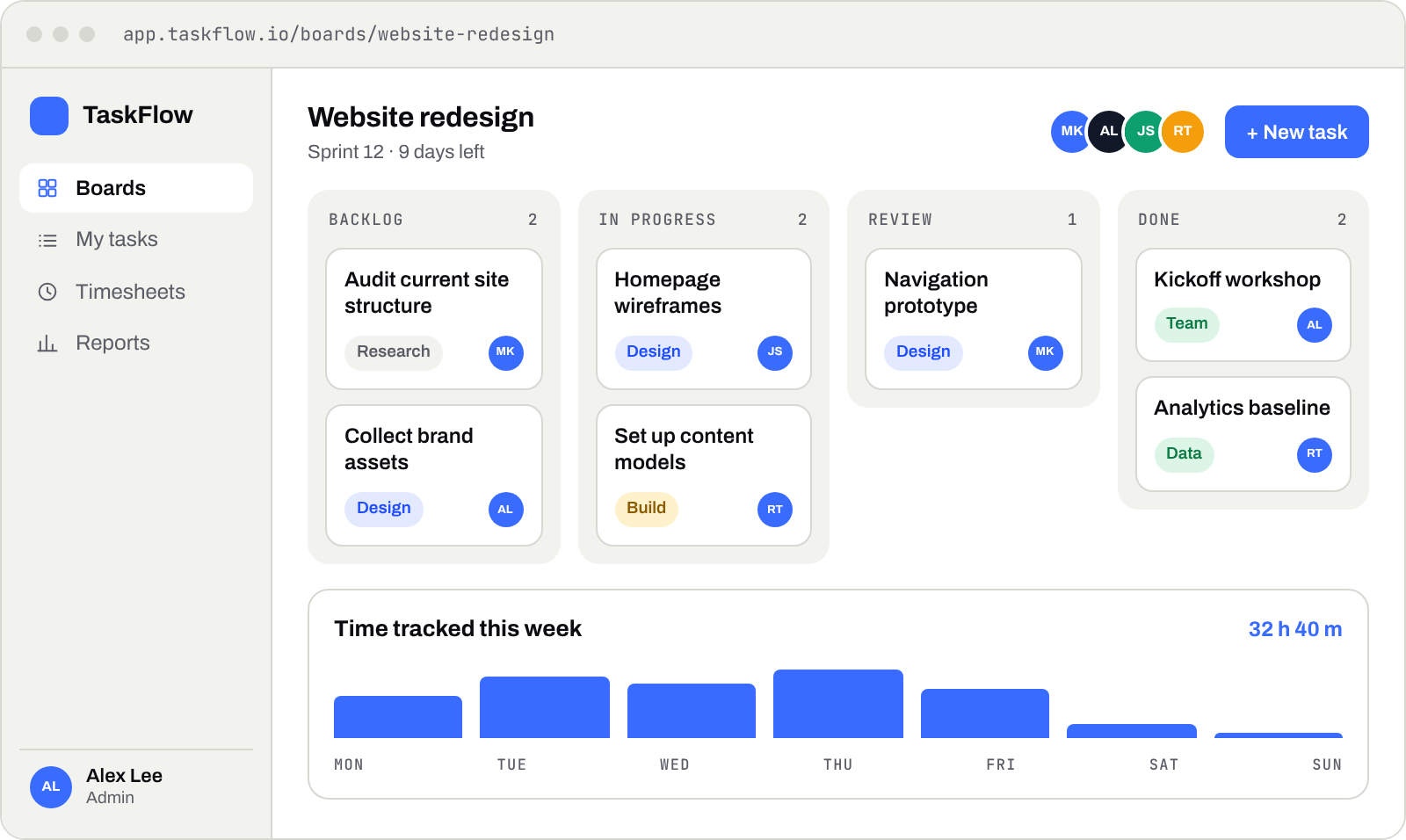
Task, project and collaboration tools with complex state and real-time updates.
APIs and back ends
Node.js services with validated inputs and typed responses.
JavaScript migrations
Moving existing JavaScript codebases to TypeScript one file at a time.
Shipped with it.
Projects from our portfolio built with TypeScript. Open one for its screens, features and stack.
Better together.
The technologies we most often combine with TypeScript. Each has its own page.
From first call to live app.
A proven five-stage process that eliminates guesswork, keeps you in control, and delivers on time.
Discovery & Scoping
We learn your business, map your users, and define exactly what needs to be built. No guesswork. No assumptions.
Design & Prototype
Wireframes and interactive prototypes so you can see and feel the app before a single line of code is written.
Development Sprints
Agile two-week sprints. You see real progress regularly. Feedback is built in — not bolted on at the end.
QA & Testing
Rigorous testing across devices, edge cases, and real-world scenarios. We find the bugs so your users don't.
Launch & Support
App Store submission, launch support, and an ongoing maintenance plan to keep everything running smoothly.
Questions, answered.
What clients most often ask us about TypeScript. Something else on your mind? Ask us directly.
01Does TypeScript slow development down?
Only slightly at the very start. After that it speeds things up: better autocomplete, fewer bugs to chase and safer changes. On any project that lasts more than a few weeks, it pays for itself.
02Can you convert our JavaScript codebase to TypeScript?
Yes. TypeScript and JavaScript can live side by side, so we convert gradually, starting with shared models and the most-changed files, without stopping feature work.
03Does TypeScript make the app faster?
Not directly. It compiles to the same JavaScript. The benefit is fewer bugs and code that is easier to keep fast and correct as it grows.
04Do you use strict mode?
Yes, on new projects. Strict checks catch the most mistakes, especially around missing or empty values.
05How do types stay in sync with the API?
We generate or share them: from the database schema, from a GraphQL schema or from shared validation code, so the front end and back end cannot quietly drift apart.
06Can TypeScript be used on the back end too?
Yes, and we recommend it. With Node.js on the server, the same types describe the API on both sides, so a renamed field or a new required value is caught everywhere at once instead of breaking the app after release.
Ready to build something that actually works?
Get a free strategy call with our team. No hard sell. No obligation. Just an honest conversation about what you need to build and whether we're the right fit.